
Resources

Mapping Liquidity Red Flags → Senior Housing & OZ Capital Timing
Market Intelligence Mapping Liquidity Red Flags → Senior Housing & OZ Capital Timing A decision-oriented framework linking today’s liquidity signals to senior housing execution risk
Commercial Real Estate Impact: Japan Just Broke the Global Financial System
Macro Shock & Commercial Real Estate Japan’s Rate Shock and What It Means for Commercial Real Estate Japan’s 20-year bond yield jumping to 2.75% marks
Navigating the Fog: Understanding the Current U.S. Real Estate Market Context (2026)
White Paper • 2026 Outlook Navigating the Fog: Current U.S. Real Estate Market Context A five-minute executive brief for HNWIs, Family Offices, and RIAs—why Senior

Senior Housing: The Next Frontier of Commercial Real Estate
Senior Housing: The Next Frontier of Commercial Real Estate Why seasoned CRE investors are turning to the demographic engine driving America’s most resilient real-estate opportunity.

Is Senior Housing or Multi-Family a Better Investment
Investment Outlook • 2026–2030 Senior Living vs. Multi-Family: Where to Allocate from 2026–2030 Need-based housing & care versus broad renter demand—side-by-side fundamentals, risks, and strategy.

Is Senior Housing or Industrial a Better Investment
Investment Outlook • 2026–2030 Senior Living vs. Industrial: Where to Allocate from 2026–2030 Need-based housing & care versus logistics-driven warehouses—fundamentals, risks, and strategy. Research Brief
Is Senior Housing or Data Centers a Better Investment
Investment Outlook • 2026–2030 Senior Living vs. Data Centers: Where to Allocate from 2026–2030 Need-based housing & care versus hyperscale compute infrastructure—side-by-side fundamentals, risks, and
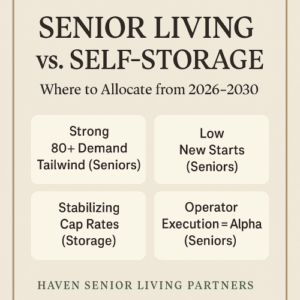
Is Senior Housing or Self Storage a Better Investment
Investment Outlook • 2026–2030 Senior Living vs. Self-Storage: Where to Allocate from 2026–2030 A side-by-side, investor-grade comparison using today’s 2025 baselines to project risk, return,

Would You Rather Give Your Money to the IRS—or Use It to Invest
Introduction Every high-income earner eventually asks the same question: “Where is all my money going?”

Why Senior Housing Stands Strong—Even as the Real Estate Cycle Peaks
As the clock ticks toward what many economists, including real estate cycle expert Phil Anderson,

The Crack in the Bond Market: Implications for Commercial Real Estate (CRE) Investors
Executive Summary A looming disruption in the U.S. bond market is raising red flags across

Unlocking Wealth Through Real Estate Syndications
Real estate syndications represent a compelling investment avenue, offering high-net-worth individuals (HNWI) the opportunity to

Investing in Senior Housing Located in Opportunity Zones: A Tax-Efficient Opportunity
The aging population in the United States continues to drive demand for senior housing, making

The Case for Alternative Investments Using Self-Directed IRAs
For millions of Americans, retirement savings are deeply tied to the stock market, with the
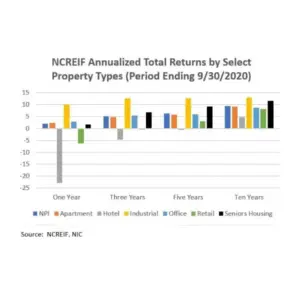
The Financial & Tax Benefits of Investing in Senior Housing Real Estate
Behind Haven Senior Living Partners’ (HSLP) operations is an abundance of financial savvy and strategy.

Investing in Senior Housing: Your Path to Impact
Guiding Investors. Transforming Senior Housing. Creating a Lasting Impact. At Haven Senior Living Partners, we

What is senior living investment, and why consider it?
Senior living investments involve allocating capital to communities providing housing and care for older adults, including independent living, assisted living, memory care, and continuing care retirement communities (CCRCs). At Haven, we view these as Redemptive.
What makes senior living a compelling investment?
Investing in senior living offers durable financial returns, stable occupancy due to growing demand, potential capital appreciation, and consistent cash flow. It’s an opportunity to generate income while positively impacting the lives of seniors and their families.
Which types of senior living facilities can I invest in? You can invest in:
Independent Living (IL)
For active seniors needing minimal assistance.
Assisted Living (AL)
For individuals requiring help with daily activities but not 24/7 medical care.
Memory Care
Specialized support for those with Alzheimer’s or other dementias.
Continuing Care Retirement Communities (CCRCs)
Offer a range of care levels, from independent living to skilled nursing, all on one campus.
Skilled Nursing Facilities (SNFs)
Provide round-the-clock medical and rehabilitative care.
How do I begin investing passively in senior living?
Start by reviewing investment opportunities offered by experienced sponsors like Haven. Evaluate market research, financial analyses, and partnership structures. Passive investments typically involve syndications, REITs, or dedicated funds managed by senior living
What risks should passive investors consider?
Common risks include regulatory changes, market saturation, operational complexities, and economic downturns. Haven prioritizes mitigating these through meticulous due diligence and operational expertise.
What is an accredited investor, and must I be one?
An accredited investor typically has a net worth over $1 million (excluding primary residence) or annual income above $200,000 ($300,000 jointly). Most private senior living investments require accredited investor status per SEC guidelines.
How exactly does passive investment work in senior living?
Passive investors contribute capital without daily management responsibilities. Investment structures include:
• Syndications
• Real Estate Investment Trusts (REITs)
• Managed Senior Living Funds
What should I evaluate before investing in a senior living project?
- Strong operator track record: Seek experienced, reputable teams with strong operational and financial performance.
- Favorable location demographics: Analyze demographic trends, competitive landscape, and demand indicators.
- Solid financial health: Review cash flow projections, debt structures, and reserves.
- Regulatory compliance: Confirm that state and federal regulations are met or exceeded.
- Clear growth strategies: Assess room for expansion, renovations, or additional care offerings.
How is technology enhancing senior living investments?
Technology like telehealth, smart-home features, and electronic health records (EHRs) improve resident care, operational efficiency, and investment value.
Are there tax advantages to senior living investments?
Yes, advantages include depreciation, mortgage interest deductions, 1031 exchange opportunities, and strategic capital gains management. Consult your tax advisor for personalized advice.
How can I track my investment’s performance?
Key metrics include Occupancy Rate, Net Operating Income (NOI), Revenue per Available Room (RevPAR), and resident satisfaction scores.
Can I invest if I'm not accredited?
Non-accredited investors can participate through publicly traded REITs or regulated crowdfunding platforms specializing in senior housing.
What lease structures are common in senior living?
Lease structures often include month-to-month agreements and entrance fee models, particularly in CCRCs.
How does the level of care influence returns?
Higher care levels like memory care or skilled nursing generate higher revenue but incur greater operational costs and regulatory complexity. Independent and assisted living typically have lower costs with stable returns.
Does government funding impact senior living investments?
Yes, Medicare and Medicaid reimbursements affect revenue streams, particularly in skilled nursing and memory care facilities. Changes in policy can influence investment risk.
What happens when selling a senior living property?
Sales involve regulatory compliance, licensing transfers, and maintaining resident and staff continuity to preserve property value.
What maintenance and capital expenditure considerations exist?
Regular maintenance sustains property value and satisfaction, while strategic renovations can significantly enhance revenue potential.
How important is insurance in senior living investments?
Insurance coverage, including property, liability, and specialized healthcare policies, is crucial to managing risks effectively.
How does staffing impact senior living investment success?
Proper staffing affects care quality, occupancy, and overall profitability. Effective staff retention strategies are vital.
What design trends influence senior living investments?
Emerging trends include wellness amenities, smart technology integration, and AI-driven care solutions enhancing resident experience and operational efficiency.
How do I assess competitive market conditions?
Analyze demographic growth, local competition, occupancy rates, pricing, and regulatory trends.
What exit strategies exist for passive investors?
Common strategies include asset sales, mergers, and utilizing 1031 exchanges for tax-deferred reinvestment.
How do healthcare policy changes affect investment outcomes?
Policy shifts impacting Medicaid and Medicare reimbursement, along with state-level regulatory adjustments, can influence investment performance.
Does sustainability matter in senior living investments?
Energy-efficient and certified green buildings reduce costs and appeal to environmentally conscious investors and residents.
How do I align senior living investments with ethical goals?
Choose operators prioritizing resident-centered care, employee satisfaction, and environmental sustainability.
Can I invest passively in senior living?
Yes, through syndications, REITs, and managed funds that require no direct hands-on management.
What questions should I ask before investing?
- Does this investment align with my financial and ethical goals?
- Is the market stable with strong long-term demand?
- Does the sponsor have a proven track record?Regulatory compliance
- What protections mitigate downside risk?
- What is a realistic timeline for returns?